Mobility & politics
A comparison with (city) limits
What to consider when comparing mobility policy in Paris and Berlin, and the role city boundaries play.
For several years, Paris has frequently been held up in Germany as an example of progressive mobility policy. Berlin is often the point of comparison: the Paris mayor’s progressive approach is contrasted with Berlin’s more conservative mobility policy.1 But where do these differences come from? Do people in Paris and Berlin really have such different preferences when it comes to mobility policy?
The simple answer is “yes.” This is evidently reflected in election results too, even though transport policy is certainly not always what decides an election. Yet it is worth looking more closely at what accounts for these differences in voters’ preferences.
This brings me to a point that is often overlooked in discussions of these comparisons. Comparing Paris and Berlin seems reasonable to many people at first glance. But when discussing urban policies such as (public) mobility and transport infrastructure, there are certain things we need to consider. City boundaries play little part in our daily lives and, ideally, do not create meaningful barriers to our mobility either. Mobility is rightly considered across municipal boundaries. At the same time, however, mobility in both Paris and Berlin is strongly shaped by city politics. And here lies a crucial difference.
When discussing major cities such as Paris, Berlin, or London, we generally look beyond the cities themselves; metropolitan regions are often what we examine and compare. The Berlin metropolitan region has around 5.5 million inhabitants.2 Of these, approximately 3.6 million3 live within Berlin’s city boundaries (about 65%). The Paris metropolitan area, by contrast, has around 12.4 million inhabitants2, with only 2.1 million3 living within the city of Paris (about 17%). In Paris, then, the 17% of metropolitan residents living closest to the centre decide their city’s (mobility) policy, whereas in Berlin that share is around 64% of the metropolitan population.
A brief thought experiment shows why this matters and how it might explain the difference in mobility policy. Looking at the election results for the 17% of Berlin residents living closest to the centre shows that the Greens would have won there in the last election, the 2023 Berlin House of Representatives election4. Presumably, they would have pursued mobility policies comparable to those we see in Paris.5 The reverse conclusion also seems reasonable, at least as a general tendency, when looking at the strongest parties in the municipalities of the Grand Paris region.6 This suggests that people in Berlin and Paris are actually closer in their political interests and preferences than the policies implemented in each city might lead us to believe. The preferences and interests reflected in election results can plausibly be interpreted as showing that similar groups—for example, voters in the centre of the urban area—have similar interests in both Berlin and Paris. However, as outlined above, city boundaries mean that the composition of the electorate differs substantially in relation to the wider urban area.
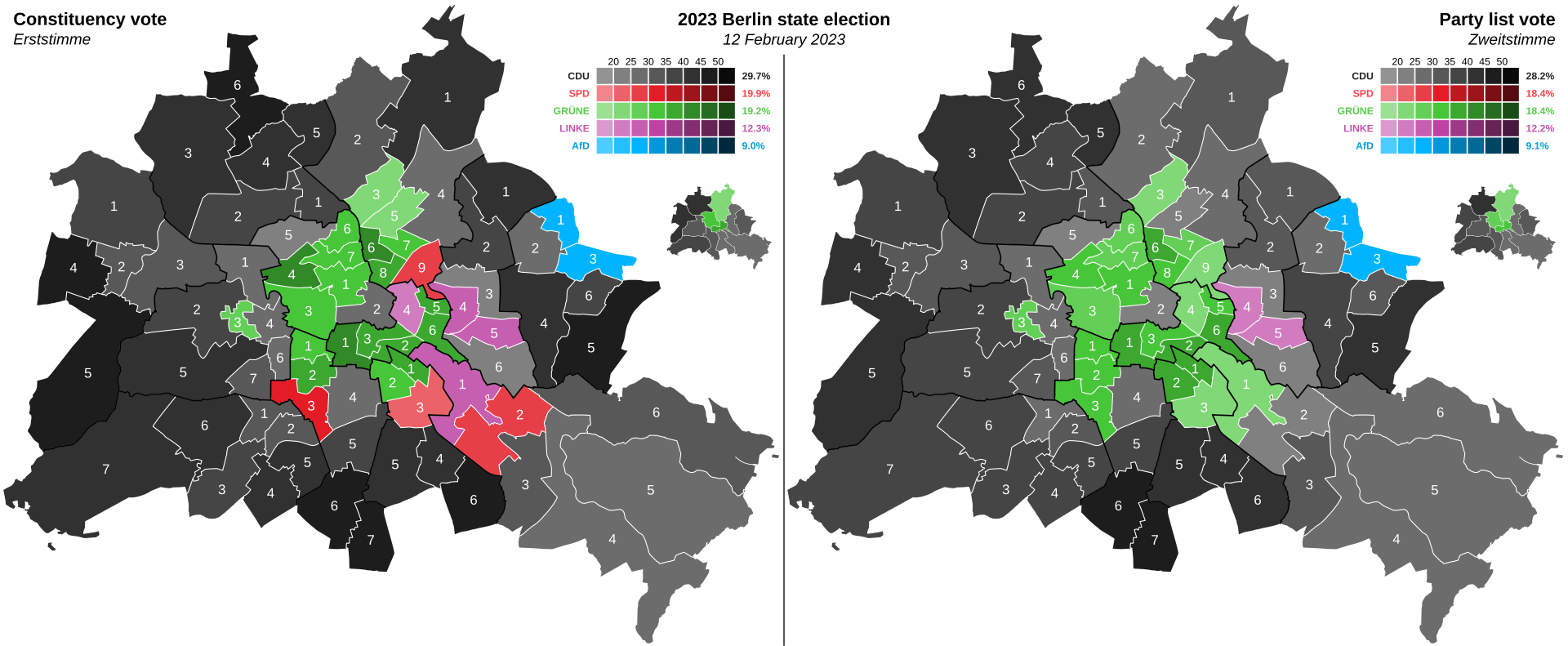
What, then, should we take away from this? It shows how careful we need to be when working with data, and how important it is to understand the subject itself if, like me, you enjoy working with statistics and numbers. Yet this can also prompt a political discussion, which is what is truly interesting and more important. When we compare policies, we also need to consider whom those policies represent. We can take this political discussion a step further and ask whether the way we determine who makes democratic decisions about (urban) mobility policy is sensible. After all, placing decision-making authority at the city level is itself a political choice, however set in stone it may appear. Policymakers can also ask whether the interests of those most affected should play a greater role in such political decisions.
Incidentally, the grass is always greener on the other side: in France, people look enviously at the Deutschlandticket and the punctuality of Berlin’s U-Bahn.8 We should certainly keep looking across borders and learning from one another. But when we ask why Berlin does not have progressive mobility policies like those in Paris, a closer look is worthwhile to understand the possible reasons for these differences.
Notes and sources
- Selected articles: https://vision-mobility.de/news/umstrittenes-a100-teilstueck-eroeffnet-berlin-ist-nicht-paris-386386.html?cmpscreencustom=; https://www.mobil.nrw/verbinden/blog/mobilitaet-in-paris-verkehrswende-ohne-kompromisse.html; https://www.eib.org/de/stories/paris-mobility; https://www.entwicklungsstadt.de/verkehrswende-und-15-minuten-stadt-in-paris-ein-modell-fuer-berlin/; https://taz.de/Verkehrswende-in-Paris/!6098945/; https://taz.de/Verkehrswende/!6049673/; https://lagedernation.org/podcast/ldn433-merz-kritisiert-israel-russlands-hybrider-krieg-kretschmer-will-nord-stream-reaktivieren-bundeswehr-setzt-auf-google-cloud-microsoft-sperrt-mail-zugang-von-istgh-chefermittler-verkehrswend/ ↩
- https://ec.europa.eu/eurostat/databrowser/view/met_pjangrp3/default/table?lang=en&category=reg_typ.met.met_demo; Figures from the election year 2023 ↩
- https://ec.europa.eu/eurostat/databrowser/view/demo_r_pjangrp3/default/table?lang=en; Figures from the election year 2023 ↩
- https://wahlen-berlin.de/wahlen/be2023/afspraes/agh/index.html; Example: combined results for the districts of Mitte, Friedrichshain-Kreuzberg, and Charlottenburg-Wilmersdorf (around 950,000 inhabitants)↩
- https://www.abgeordnetenwatch.de/sites/default/files/election-program-files/bundnis90-diegrunenwahlprogrammagh2023.pdf ↩
- https://fr.wikipedia.org/wiki/Fichier:Carte_Politique_du_Grand_Paris.png↩
- Gust Justice, CC BY-SA 4.0, via Wikimedia Commons↩
- https://www.tf1info.fr/player/3e651245-7a0e-469b-b7a0-1d03c8b92167/ ↩

